 $25 OFF AC REPAIR | $139 MAINTENANCE
 Cooling
 Heating
 Water Heater
 Other Services
Why Is My Air Conditioner Blowing Warm Air
May
An AC blowing warm air in the middle of a Calgary heatwave is one of the most stressful calls we take, and the fix is often simpler than you think. Most of the time it’s a thermostat setting, a tripped breaker at the outdoor unit, or an airflow problem at the filter or evaporator coil. The rest of the time it’s a real mechanical issue, and you’ll want same-day air conditioner repair before the house gets any warmer.
The most common reasons an AC blows warm air include an incorrect thermostat setting (fan set to “On” instead of “Auto”), a tripped breaker to the outdoor unit, a dirty air filter causing a frozen evaporator coil, low refrigerant from a slow leak, or a failed capacitor in the outdoor condenser.
This guide walks through the seven most common reasons a central AC starts pushing warm air, in the order we actually check them on a service call. Work through the first three yourself in about ten minutes. If you’re still getting warm air after that, stop poking at it and book a technician: the remaining causes involve refrigerant, electrical components, or a failing compressor, none of which are homeowner-fixable in Alberta.
In This Article
- First, Make Sure It’s Actually Warm Air
- The 7 Common Causes at a Glance
- The Thermostat Is the Number-One Culprit
- The Outdoor Unit Has Lost Power
- A Dirty Filter or Frozen Evaporator Coil
- Low Refrigerant or a Slow Leak
- Capacitor or Compressor Failure
- Preventing This Next Summer
- Frequently Asked Questions
First, Make Sure It’s Actually Warm Air
Before you start tracing the problem, confirm what you’re feeling. Put your hand in front of the nearest supply register for a full minute. Central AC that’s working correctly pushes air roughly 8 to 12 degrees Celsius cooler than the return-air temperature in the same room. On a 28 degree afternoon, you should feel air somewhere around 16 to 18 degrees at the register. That feels cool, not cold.
If the air coming out is the same temperature as the room, you have a real problem. If it’s somewhat cool but just not keeping up, you might be dealing with undersized equipment, heavy sun load, or a filter problem, which is a different conversation than a system that flat-out isn’t cooling.
People Often Ask: How Cold Should My AC Vents Be?
Supply-register air should be about 8 to 12 degrees Celsius cooler than return-air temperature. Anything less than a 6 degree drop, or warmer air at the register than in the room, points to a refrigerant, airflow, or compressor issue.
7 Common Reasons Your AC is Blowing Warm Air
- Thermostat set to “On”: The fan runs continuously even when the AC isn’t actively cooling.
- Tripped outdoor breaker: The indoor blower works, but the outdoor unit has lost power.
- Dirty air filter: Restricted airflow prevents the system from cooling properly.
- Frozen evaporator coil: Often caused by a dirty filter; blocks cold air from reaching your vents.
- Low refrigerant (leak): The system lacks the chemical needed to remove heat from your home.
- Failed run capacitor: The outdoor fan spins, but the compressor cannot start.
- Compressor failure: The main engine of your cooling system has mechanically broken down.
The Thermostat Is the Number-One Culprit
More than a third of “warm air” service calls end with the thermostat. Walk over to it and check three things before you touch anything else.
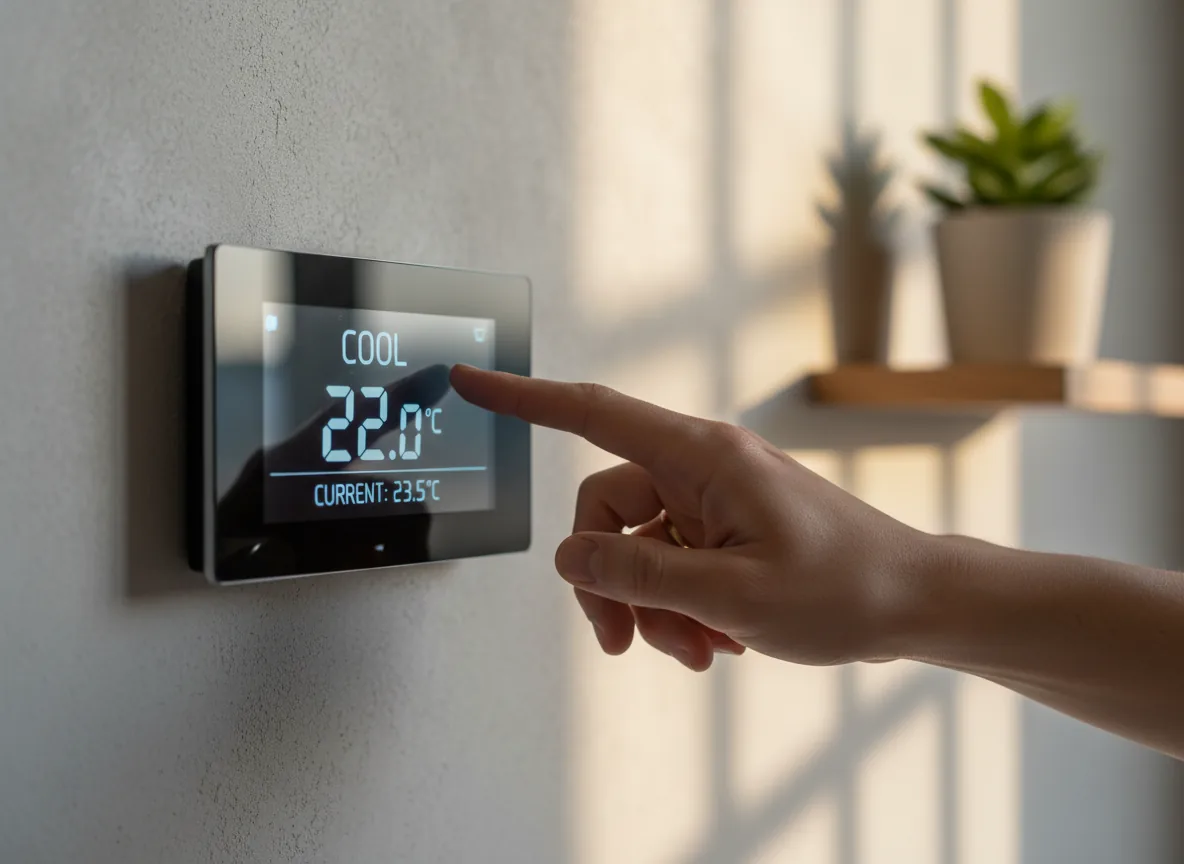
Mode. The selector should read Cool, not Heat and not Off. On smart thermostats, make sure an automated schedule hasn’t flipped it to Heat because of a stale profile.
Fan setting. This one traps almost everyone. If the fan is set to On, the blower runs nonstop, even when the outdoor unit isn’t cooling. So during every cycle gap you feel room-temperature air blowing out of the vents and it feels exactly like the AC has quit. Set the fan to Auto so the blower only runs when the system is actively cooling.
Setpoint and batteries. Drop the target temperature 3 to 4 degrees below the current room temp to force a cycle. If nothing happens, pop the thermostat off the wall and check the batteries, or check the breaker that powers a hardwired C-wire. A low-voltage thermostat with dying batteries will display a setpoint without actually sending the call-for-cool signal to the outdoor unit.
The Outdoor Unit Has Lost Power
A central AC has two separate power feeds: one to the indoor air handler and furnace, and a second 240-volt feed to the outdoor condenser. You can have a running furnace fan (which is what moves air through your vents) while the outdoor unit sits dead in the backyard. The result is exactly what you’re feeling: the vents blow, but the air isn’t getting cooled.
Walk outside and listen near the condenser. You should hear the fan spinning and a steady hum from the compressor whenever the thermostat calls for cool. If it’s silent, check two places:
- The outdoor disconnect switch. This is a small grey box mounted on the wall near the condenser. Open it and make sure the pullout handle or rocker switch is in the On position. People knock these loose with lawnmowers and ladders more often than you’d think.
- The main panel breaker. Look for a double-pole 30-amp or 40-amp breaker labeled “AC” or “Condenser.” If it’s tripped, it will sit between On and Off, or fully at Off. Flip it fully Off, then back to On. If it trips again within minutes, stop. A breaker that trips repeatedly means something on the condenser side is drawing too much current. That’s a technician job, not a reset-and-hope job.
A Dirty Filter or Frozen Evaporator Coil
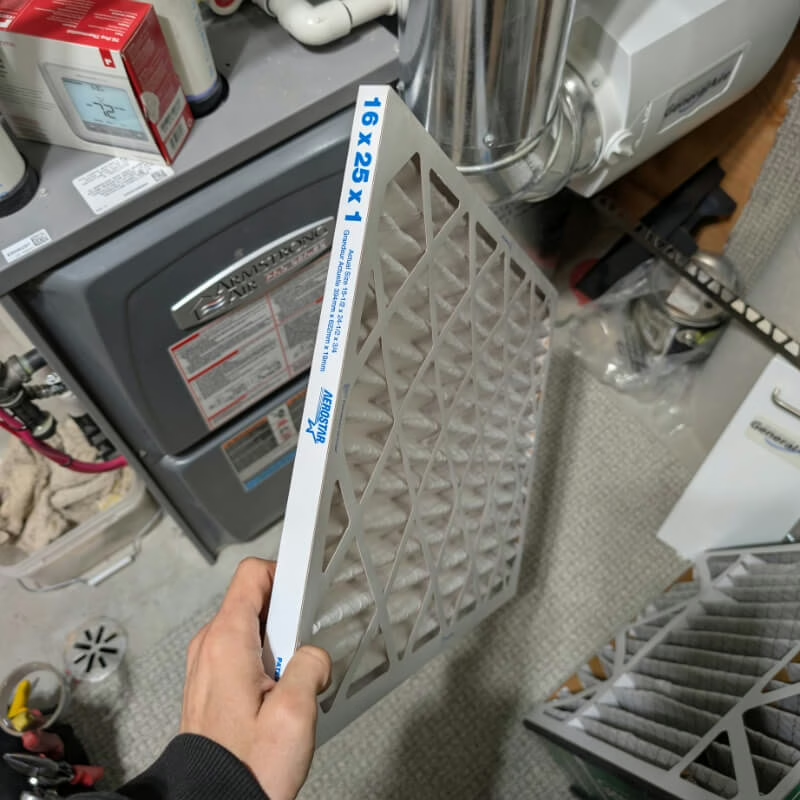
Airflow problems are the sneakiest cause of warm-air complaints because the symptoms build slowly. A filter that’s been in place for four or five months restricts return air enough that the evaporator coil inside your furnace cabinet can actually freeze into a block of ice during operation. Once that happens, no air passes through it, and the blower just pushes room-temperature air back out the supply vents.
Pull the filter and hold it up to a light. If you can’t see any light through it, it’s done. Replace it with the same size, same direction (the arrow points toward the furnace), and close the compartment fully. Check whether your furnace has a door switch that needs the panel seated correctly for the system to run at all.
If you suspect the coil is frozen (telltale sign: water pooling around the furnace cabinet, or frost visible on the copper refrigerant lines near the indoor unit), turn the AC off at the thermostat and set the fan to On. Leave it running for 2 to 3 hours so the blower can thaw the coil without the compressor working against it. Then change the filter and restart the system. If it ices up again within a day, the underlying issue is almost always low refrigerant, and you’re into the next section.
Pro Tip
Replace 1-inch pleated filters every 60 to 90 days during active cooling season. In Calgary, the wildfire-smoke weeks in late summer shorten that window considerably. A filter you could push an extra month through in June is not the same filter you’ll have in late August.
Low Refrigerant or a Slow Leak
If the airflow is fine but the air still isn’t cold, the refrigerant charge is the next suspect. Refrigerant doesn’t get used up like fuel. It circulates in a sealed loop for the life of the unit. So if a system is low, it’s because it’s leaking, and a pro has to find the leak, repair it, and recharge the system to the manufacturer’s spec.
This is not a DIY job in Alberta. Refrigerant handling is federally regulated under the Canadian environmental regulations covering ozone-depleting substances, and only certified technicians can legally purchase refrigerant and open a sealed system. More practically, the gauges, recovery equipment, and training to charge R-410A correctly all cost more than paying someone to do it once.
What you can do: listen for a hissing sound near the indoor coil or the outdoor service valves (a common leak spot), and look for an oily residue on copper lines. Those are clues to hand the technician when they arrive, not problems you solve on your own. Expect a proper leak repair and recharge to start at approx. a few hundred dollars and climb depending on where the leak is and how much refrigerant was lost.
Did You Know
Since 2020, new Canadian residential AC systems have been transitioning from R-22 to R-410A, and more recently to R-32 and R-454B for new equipment. If your AC is 15+ years old and still runs on R-22, the refrigerant itself is now expensive and getting scarce. At that point a repair often costs more than upgrading the unit.
Capacitor or Compressor Failure
If the outdoor fan is running but the compressor isn’t (you’ll hear the fan spinning but no low hum or vibration from the compressor body), the most common cause on a 5 to 10 year old unit is a failed run capacitor. The capacitor is a cylindrical component inside the outdoor unit’s electrical panel that stores the energy needed to kick the compressor into each cycle. They’re consumable parts, and Calgary’s temperature swings are hard on them.
A technician can test a capacitor in under five minutes with a multimeter, and replacing one is typically a 30-minute visit. Southern Alberta temperature swings are hard on capacitors, so on systems more than five years old this is one of the first components we check. It’s also one of the most satisfying repairs to call in because the fix is immediate and not especially expensive.
If the compressor itself has failed, the calculus changes. Compressor replacements on older units often approach the cost of a new matched system, and a good contractor will walk you through both options honestly rather than defaulting to “replace the compressor.” If your system is past 12 years, and you’re already into year-four of repairs, this is usually the service call where a new AC installation starts to make more sense than another patch.
Preventing This Next Summer
Most warm-air emergencies are avoidable. A 30-minute spring tune-up catches a weak capacitor, a clogged condensate drain, a low refrigerant charge, and a dirty outdoor coil before any of them become a failure during the first heatwave. Homeowners booking seasonal HVAC service in Airdrie and Okotoks HVAC tune-ups start calling in April because the rural service windows fill up first; in-city homeowners tend to wait and then compete for the same June slots.
Three things to do every year, no matter who services your system:
- Have the outdoor condenser coils rinsed clean with a garden hose (power off first) every spring. A coil caked in cottonwood fluff or wildfire ash can’t reject heat, which makes the system run warm even when nothing is technically broken.
- Keep the area within 60 cm of the outdoor unit clear of plants, furniture, and fencing. The condenser breathes; block it and it overheats.
- Set a phone reminder for filter changes every 60 days during cooling season. More frequent in smoke season.
If your AC is already nine or ten summers old, factor in a load calculation on the house as well. Homes across our broader HVAC service area have gained square footage through renovations and basement developments faster than most systems have been resized to match, which is another reason “the AC is blowing warm air” can actually mean “the AC is undersized for what the house has become.”
Take the Diagnostic Guide With You
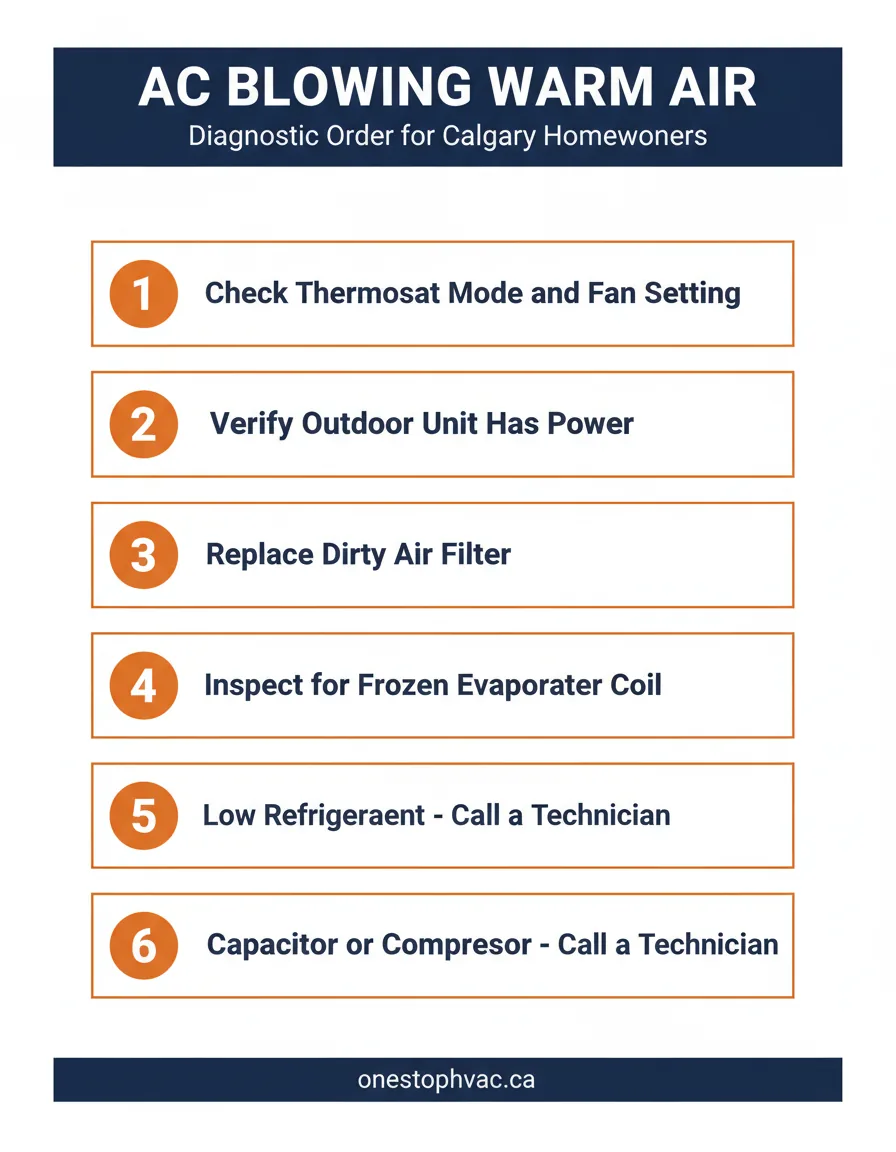
Print or save the full 6-step AC warm-air diagnostic order – the one we actually use on service calls.
Frequently Asked Questions
Why Is Cool Air Coming Out of Some Vents but Not Others?
That is usually a ductwork problem rather than an AC problem. Check for closed dampers in unused rooms, crushed flex duct in the basement or attic, or a failing zone controller. If every vent is blowing equally warm air the cause is at the equipment; if it is room-to-room inconsistent the cause is in the distribution.
How Long Can I Run My AC With Warm Air Coming Out Before I Damage It?
If the compressor is working against a frozen coil or low refrigerant, every hour of operation shortens its lifespan. Turn the cooling off at the thermostat as soon as you notice the problem and leave the fan on Auto. Warm air through ductwork for an afternoon while you wait for a technician causes no harm; a compressor grinding against restricted flow for two days can cost you the compressor.
Can I Add Refrigerant Myself to Fix a Warm-Air Problem?
No. Purchasing R-410A or R-32 refrigerant requires provincial certification, and opening a sealed refrigerant system without recovery equipment vents regulated gases into the atmosphere. Beyond the legal issue, charging by feel rather than by subcooling or superheat measurements almost always overcharges it, which damages the compressor faster than the original leak would have.
My Outdoor Unit Is Running but the House Still Feels Warm. What Is Next?
If the thermostat is in Cool mode, the filter is clean, and the outdoor unit is spinning up normally, the next likely issues are a low refrigerant charge, a partially blocked condenser coil, or an undersized system for the current load. Any of those three needs a technician with gauges and a temperature probe to diagnose properly.
How Much Does an AC Warm-Air Service Call Cost in Calgary?
A standard diagnostic visit starts at approx. a flat service-call rate that covers travel and the first 30 to 45 minutes of troubleshooting. If the fix is a capacitor or a cleaning, it is often done inside the same visit. Refrigerant repairs, compressor issues, and coil replacements are quoted separately after diagnosis. Always ask for the written estimate before authorizing the repair.
Keep Reading
One Stop HVAC handles warm-air diagnostics and emergency air conditioning service across the Calgary Metropolitan Region, including Airdrie, Cochrane, Okotoks, Chestermere, and Canmore. If your AC is blowing warm air and you’ve already checked the thermostat, breaker, and filter without luck, request a service call and we’ll get a technician on the way.