 $25 OFF AC REPAIR | $139 MAINTENANCE
 Cooling
 Heating
 Water Heater
 Other Services
Why Your Calgary Home Needs an HRV (and How It Works)
Apr
In this article
An HRV system is the single most effective upgrade you can make for fresh air in a Calgary home. If your house was built or renovated in the last 20 years, it was likely sealed tight to meet Alberta’s energy code, and that tight envelope traps stale air, moisture, and CO2 inside all winter. An HRV installation in Calgary solves this by exchanging indoor and outdoor air through a heat-recovery core, so you get ventilation without throwing away the heat you paid for.
This guide covers how the system works, why Calgary’s climate makes it nearly essential, what it costs, and how to maintain it. If you have been dealing with stuffy rooms, condensation on windows, or dry air that no humidifier seems to fix, keep reading.
What is an HRV system?
HRV stands for Heat Recovery Ventilator. It is a mechanical ventilation device that brings fresh outdoor air into your home while simultaneously exhausting stale indoor air. The key difference between an HRV and simply opening a window is the heat exchange core at the centre of the unit. As warm outgoing air passes through this core, it transfers 70% to 80% of its heat energy to the cold incoming air stream. The two air streams never mix. You get fresh air without the energy penalty.
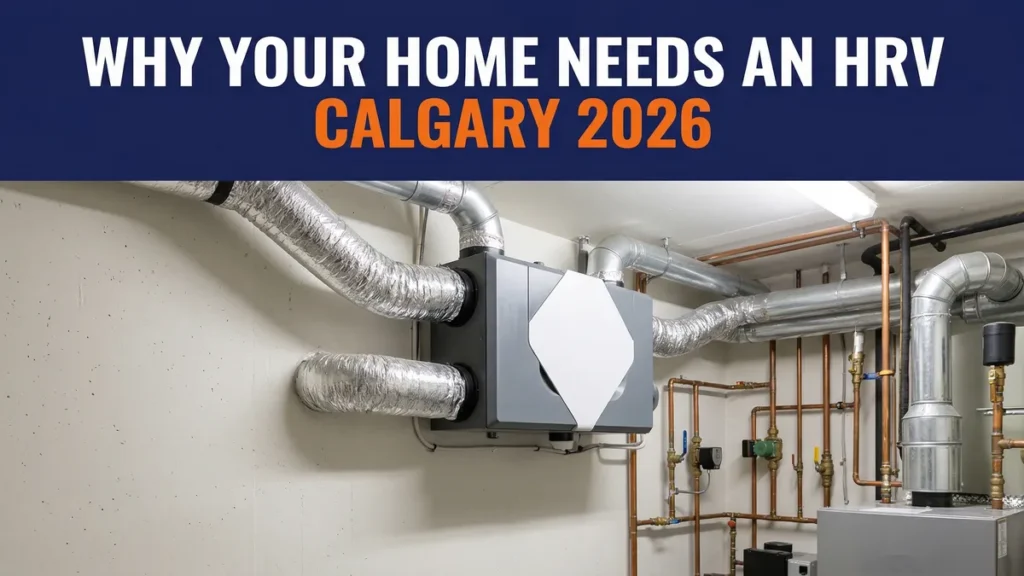
In practical terms, an HRV is a box roughly the size of a small suitcase, usually installed near your furnace or in a utility room. It connects to your existing ductwork through dedicated supply and exhaust runs. Most Calgary homes with forced-air heating can integrate an HRV system into their current duct layout with minimal modification.
People often ask: do I need an HRV if I already have a furnace fan?
Your furnace fan recirculates the same indoor air. It does not bring in fresh air from outside or remove stale air. An HRV system does both while recovering heat, which is something a furnace fan was never designed to do.
How an HRV actually works
The system runs two separate air streams through a single heat exchange core. Here is the process, step by step.
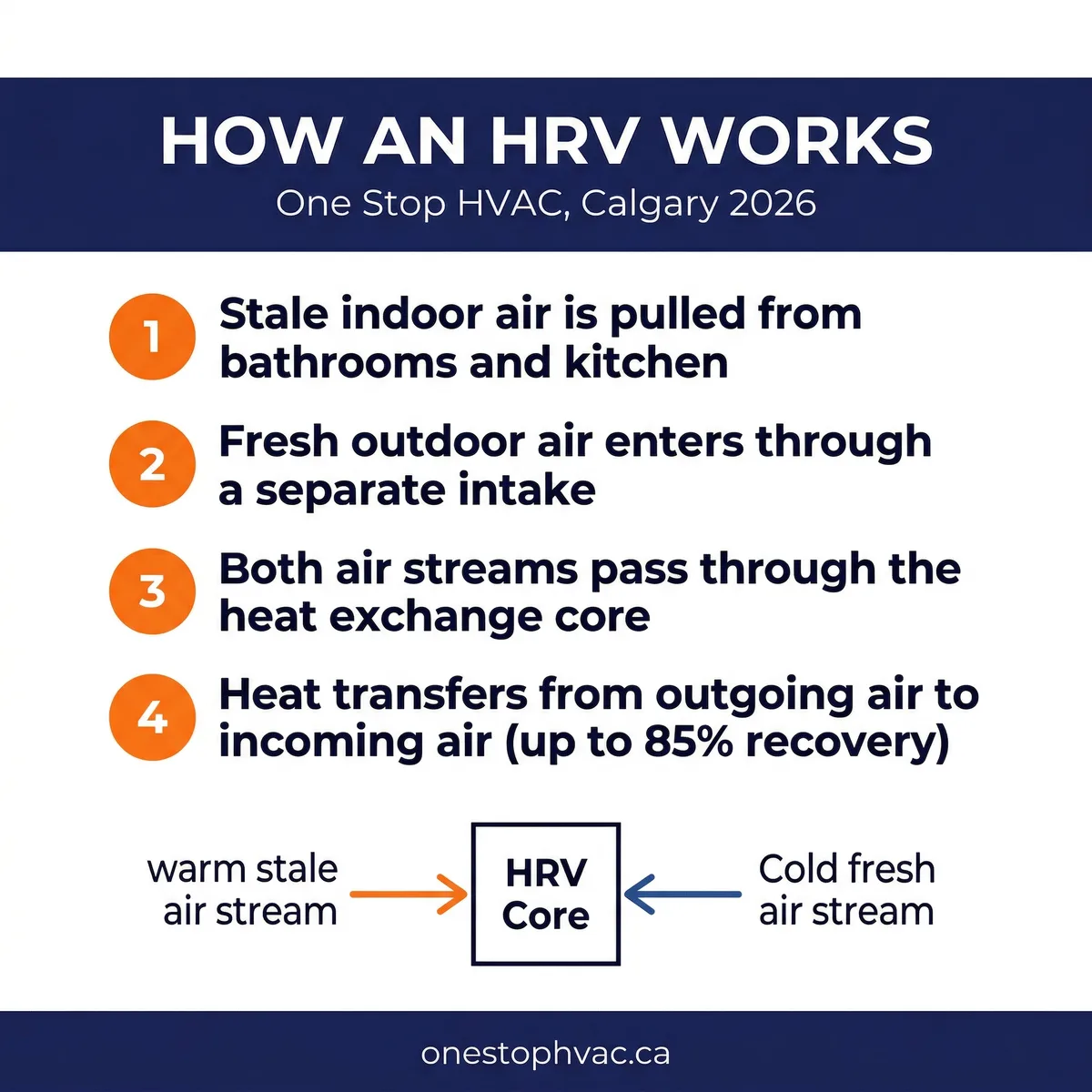
- Exhaust stream. A fan pulls stale, warm air from kitchens, bathrooms, and utility areas through dedicated exhaust ducts. This air carries moisture, odours, CO2, and volatile organic compounds (VOCs).
- Supply stream. A second fan draws cold, fresh outdoor air in through a separate intake duct, usually mounted on an exterior wall.
- Heat exchange. Both streams pass through the core at the same time, in opposite directions. The core is made of thin aluminum or polymer plates that let heat transfer from the warm outgoing stream to the cold incoming stream. At peak efficiency, 75% to 85% of the heat is recovered.
- Distribution. The now pre-warmed fresh air enters your ductwork and circulates through the house. The cooled exhaust air exits outdoors through a separate vent.
- Defrost cycle. In extreme cold (below minus 20 Celsius, a regular occurrence in Calgary), the core can frost up. Most modern HRVs have an automatic defrost cycle that temporarily recirculates air to warm the core back up.
The two air streams never physically touch each other inside the core. That means outdoor pollutants, exhaust fumes, and allergens stay outside. Indoor contaminants leave. Only heat energy crosses the boundary.
Why Calgary homes need an HRV system
Calgary is not like most Canadian cities when it comes to indoor air. The combination of extreme cold, low outdoor humidity, and modern building practices creates a specific set of problems that an HRV system directly addresses.
Tight building envelopes trap everything inside
Homes built to the current Alberta building code standards are sealed significantly tighter than homes from the 1980s or 1990s. That is great for energy efficiency. It is terrible for air quality. In a well-sealed home with no mechanical ventilation, CO2 levels can climb above 1,000 ppm overnight in a bedroom with two people. You wake up groggy, and the air feels heavy. That is not just a feeling. It is measurable.
Calgary winters mean windows stay shut for six months
From late October through April, opening a window is not a realistic ventilation strategy. Outdoor temperatures routinely sit below minus 15 Celsius, and chinook winds are unpredictable. Without mechanical ventilation, indoor air gets recirculated endlessly through furnace filters that catch dust but do nothing for CO2, cooking fumes, or outgassing from furniture and flooring.
Dry air and moisture imbalance
Calgary’s winter air is already among the driest in Canada. When that air gets heated by your furnace, relative humidity indoors can drop below 20%. That causes cracked skin, static electricity, and damage to hardwood floors. Some homeowners run humidifier systems to compensate. But without controlled ventilation, adding moisture to a tight home creates condensation on windows and can lead to mould in wall cavities. An HRV gives you the ventilation needed to safely run a humidifier.
Did you know?
According to Natural Resources Canada’s home energy guidelines, a family of four produces roughly 10 to 15 litres of moisture per day just from breathing, cooking, and showering. In a sealed home without an HRV, that moisture has nowhere to go.
The real benefits of installing an HRV
Homeowners who install an HRV system in Calgary typically notice three things within the first week: the air smells different (cleaner), window condensation drops, and the house does not feel as stuffy when they wake up. Beyond the immediate comfort improvements, the long-term benefits are practical.
- Fresh air without heat loss. The heat exchange core recovers 70% to 85% of outgoing heat, depending on the model and outdoor temperature. On a minus 25 Celsius day, incoming air that would be minus 25 enters your ductwork at roughly 10 to 15 degrees Celsius instead. Your furnace barely notices the difference.
- Reduced condensation and mould risk. Controlled air exchange keeps indoor humidity in the 30% to 40% range where it should be during winter. No more streams of water running down windows every morning.
- Lower heating costs over time. A well-maintained HRV uses 50 to 150 watts of electricity (roughly $5 to $12 per month at Alberta rates). The heat it recovers saves far more than that in gas costs, especially in homes that currently rely on bathroom exhaust fans or cracked windows for ventilation.
- Better air for allergy and asthma sufferers. Paired with a HEPA filtration system, an HRV ensures a constant supply of filtered fresh air. Indoor pollutants like VOCs, pet dander, and dust mite allergens get exhausted instead of recirculated.
- Code compliance. Alberta’s building code requires mechanical ventilation in new construction. If your home was built after 2006, it likely already has ductwork roughed in for an HRV. If it was not connected, you are missing a system the house was designed to have.
HRV vs ERV: which one do you need?
This is one of the most common questions homeowners ask when researching ventilation. The short answer for Calgary: you almost certainly want an HRV, not an ERV.
| HRV | ERV | |
|---|---|---|
| Transfers | Heat only | Heat and moisture |
| Best climate | Cold, dry winters (Calgary) | Hot, humid summers (Ontario, BC coast) |
| Humidity handling | Removes excess indoor moisture | Retains indoor moisture in winter |
| Condensation control | Excellent | Moderate |
| Typical cost | $2,500 to $5,000 installed | $3,000 to $6,000 installed |
An ERV (Energy Recovery Ventilator) transfers both heat and moisture between the air streams. In humid climates, that is useful because it prevents outdoor humidity from entering the home in summer. In Calgary, our problem is the opposite: too little moisture indoors during winter. An HRV strips excess humidity out of the house through the exhaust stream, which is exactly what you want when condensation is forming on your windows. If you run a whole-home humidifier, the HRV lets you control how much moisture stays indoors by adjusting the ventilation rate.
The exception: if you have a very large home with an indoor pool or hot tub, an ERV might be worth considering. For the average Calgary home, stick with an HRV.
What does an HRV system cost to install in Calgary?
Installation costs depend on whether your home already has ductwork roughed in for ventilation and how complex the routing needs to be.
| Scenario | Estimated cost |
|---|---|
| HRV unit only (equipment) | $800 to $2,000 |
| Standard install (pre-ducted home) | $2,500 to $4,000 |
| Full install with new ductwork | $3,500 to $5,000 |
| Premium unit (Lifebreath, Broan, vanEE) | $4,000 to $6,500 |
Pricing disclaimer: The cost ranges on this page are estimates based on typical Calgary-area market rates as of 2026. Actual quotes will vary based on your specific system, the brand and availability of parts, your home’s accessibility, labour rates in your area, and whether the work is performed during regular hours or as an emergency call. These figures are provided for general planning purposes only. One Stop HVAC does not guarantee any specific price. Always request a written quote before authorizing any HVAC work.
HRV Energy Savings Estimator
Homes built after 2006 in Calgary usually have ventilation ductwork roughed in during construction. If your builder connected it to a basic exhaust fan or left the hookups capped, upgrading to a proper HRV unit is straightforward and falls in the $2,500 to $4,000 range. Older homes without any ventilation ductwork will need new runs, which pushes the cost toward the higher end.
Save your money
If your home already has HRV ductwork roughed in but the unit was never installed, you could save $800 to $1,500 on installation costs compared to a full retrofit. Check your utility room for capped 6-inch duct ports near the furnace. That is the sign your builder planned for an HRV but did not include one.
Maintenance: keeping your HRV running properly
An HRV system is low-maintenance, but it is not zero-maintenance. Neglect it for two or three years, and airflow drops, energy recovery drops, and the unit works harder for less result. The good news: most of the maintenance is simple enough to do yourself.
Filter cleaning (every 2 to 3 months)
Most HRV units have washable foam or aluminum mesh filters. Pull them out, rinse under warm water, let them dry completely, and slide them back in. This takes five minutes. If you have pets or live near a construction zone, check them monthly. Clogged filters restrict airflow and force the fans to work harder, which increases noise and electricity use.
Core inspection (once per year)
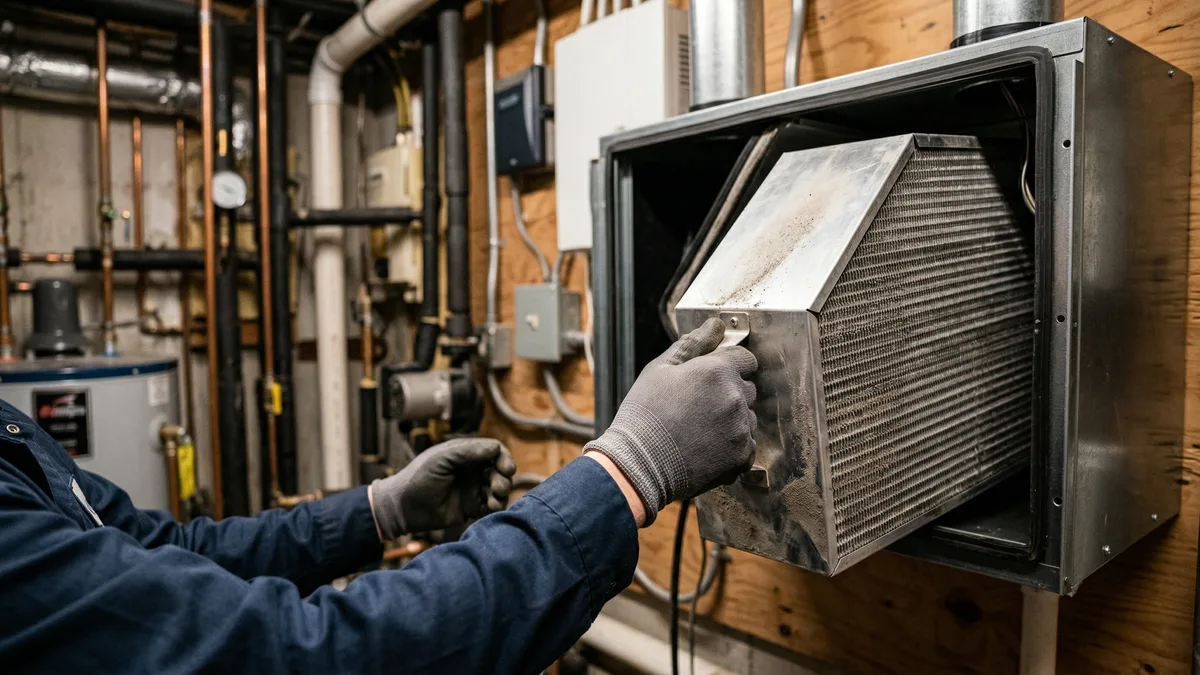
The heat exchange core should be removed and inspected annually. Soak it in warm soapy water for 15 to 20 minutes, rinse thoroughly, and let it air dry before reinstalling. Over time, dust and kitchen grease can coat the core surfaces and reduce heat transfer efficiency. A clean core recovers noticeably more heat than a dirty one.
Condensate drain check (every fall)
HRVs produce condensate when warm moist exhaust air hits the cold core. That water drains through a small hose to a floor drain. Before heating season starts, pour a cup of water into the drain pan to confirm it flows freely. A blocked drain can cause water to back up inside the unit and damage the motor or electronics.
Exterior hoods (twice per year)
Check the intake and exhaust hoods on the outside of your house. Clear away leaves, snow, ice, or bird nests. In Calgary, chinook-driven ice buildup on the exhaust hood is common in January and February. If the hood gets blocked, the unit cannot exhaust air and the defrost cycle runs constantly, which wastes electricity.
Pro tip
Label the month and year on your HRV core with a permanent marker every time you clean it. When a technician comes for an annual furnace inspection, they can see at a glance whether the core has been maintained. This also helps you track the cleaning cycle without relying on memory.
Download: HRV Homeowner Guide
Maintenance schedule, cost breakdown, and benefits checklist in one printable PDF.
Frequently asked questions
How long does an HRV system last?
A well-maintained HRV typically lasts 15 to 20 years. The fans and motors are the components most likely to wear out first. Annual core cleaning and regular filter changes are the biggest factors in longevity. Brands like Lifebreath and Broan have units that routinely hit 20 years in Calgary homes with proper care.
Does an HRV system make my home colder in winter?
No. The heat exchange core pre-warms incoming air using heat from the outgoing exhaust stream. On a minus 30 Celsius day in Calgary, the incoming air enters your ductwork at roughly 5 to 15 degrees Celsius instead of minus 30. Your furnace handles the remaining gap easily. You will not feel a draft from the supply registers.
Can I install an HRV in an older Calgary home?
Yes. Older homes often benefit the most from an HRV because they tend to have been sealed with blown-in insulation and new windows during renovations, creating the same tight-envelope conditions as new construction. The installation is more involved if no ventilation ductwork exists, but it is a common retrofit in Calgary bungalows and bi-levels from the 1960s through 1980s.
How much electricity does an HRV use?
Most residential HRVs draw 50 to 150 watts on their standard setting. At Alberta’s average electricity rate (roughly 17 cents per kWh in 2026), that works out to $6 to $18 per month for continuous operation. The heat energy recovered far exceeds this cost, especially during the heating season.
Should I run my HRV all winter or just sometimes?
Run it continuously on a low or medium setting during heating season. The system is designed for steady-state operation. Turning it on and off causes humidity swings and lets CO2 build up during the off periods. Most modern HRV controls have a low, medium, and high fan speed setting. Low speed is fine for day-to-day use. Switch to high during cooking or when you have guests over.
One Stop HVAC installs and services HRV systems across Calgary and surrounding communities including Airdrie, Cochrane, and Okotoks. If your home feels stuffy in winter, has condensation problems, or you want to improve indoor air quality without wasting energy, get in touch with our air quality team for a free assessment.
Fresh air should not be a luxury. If you have questions about HRV systems or want to find out whether your home already has ventilation ductwork roughed in, contact One Stop HVAC for a no-obligation assessment.